

REVIEW · NAIROBI CITY TOURS
Nairobi City Walk Tour
Nairobi makes sense on foot. This city walk threads together big landmarks, everyday street life, and quick lessons from local guides, so you feel like you understand Nairobi, not just pass it. I especially liked the guided storytelling and the easy-to-plan route through the city center with stops that are all short and focused.
I also love that so many stops are admission-free, including Jamia Mosque, McMillan Memorial Library, the main markets, Uhuru Park, and the National Archives. And if you want a wow moment, the Kenyatta International Conference Center rooftop view is built in, with the only catch being that the rooftop admission is not included.
One thing to consider: this is still a walking tour, so you will cover plenty of ground in roughly 2 hours 40 minutes. Also, one site (the conference center rooftop) has an extra cost, so it helps to plan for that before you go.
In This Review
- Key highlights you will care about
- Getting your bearings at St. Ellis, Carrefour, and Wabera
- Jamia Mosque and McMillan Memorial Library in the first 20 minutes
- City Market and Maasai Market for souvenirs that actually mean something
- University of Nairobi and Uhuru Park, a green reset mid-tour
- Cathedral Basilica and Parliament Tower, where faith and government meet
- Kenyatta International Conference Center rooftop: the view moment
- Railway Museum and National Archives on Moi Avenue
- Jeevanjee Gardens, a quiet finishing touch in the city center
- Why the guide makes this tour work: John, Samson, and clear explanations
- How long you will be walking, and who this fits best
- Price and value: $20 for a packed, mostly free route
- Should you book this Nairobi City Walk Tour?
- FAQ
- Is the Nairobi City Walk Tour admission-free at most stops?
- How long is the Nairobi City Walk Tour?
- What does the tour cost, and what is included in the price?
- Which stop has an additional ticket cost?
- Where does the tour start and end?
- How big are the groups, and is it near public transportation?
Key highlights you will care about

- Jamia Mosque as the opener sets the tone with a major national landmark.
- McMillan Memorial Library (1929) gives you an easy way to connect Nairobi to Kenya’s colonial-era timeline.
- Two market stops give you a practical chance to compare traditional crafts and souvenirs, including Maasai items.
- Uhuru Park break is a welcome green pause right in the middle of the city.
- Rooftop views at Kenyatta International Conference Center add a skyline moment (ticket not included).
- Railway Museum and National Archives ground the walk in how Nairobi grew after independence-era milestones.
Nairobi covered at street level and by minivan
Getting your bearings at St. Ellis, Carrefour, and Wabera

You start at Carrefour St. Ellis, right around Wabera St in Nairobi’s central area. The location is marked clearly on the booking info, and the good news is you do not need private transportation to make this work, since it is noted as near public transport.
The tour runs back to the same meeting point, which matters in a city where plans can get complicated fast. You also get a mobile ticket, so you can keep everything simple on your phone and focus on the route.
One detail I really like for first-timers is the pacing. Stops are short and deliberate, so you get a steady flow of sights without feeling stuck in one place too long.
Jamia Mosque and McMillan Memorial Library in the first 20 minutes
The tour kicks off at Jamia Mosque, described as the biggest mosque in Kenya. Going first is smart because it instantly shows you Nairobi’s religious and cultural scale, and it helps you start the day with context instead of just snapping photos.
Right after, you move to McMillan Memorial Library, built in 1929 to remember William Macmillan by his wife. Even if you are not a museum person, this is a great stop for history in a human way, because it connects a building to a real person and a specific year.
These two early stops are also a practical win: both are listed as free admission. That means your day stays predictable, and you can spend your money on the parts you want, like souvenirs, rather than adding fees site by site.
City Market and Maasai Market for souvenirs that actually mean something
Next come two market stops: City Market and the Maasai Market. City Market is framed as a place for traditional items across different communities, with a special note on Maasai-made items. This is ideal if you want a quick, broad look at what different groups create and what kinds of crafts you can expect in Nairobi.
Then the Maasai Market narrows the focus. It is presented as one of the best places for Maasai souvenirs, while still including items from other tribes in Kenya. In real terms, you get a better chance to compare style and materials between the two markets, instead of just stopping at one stall area and calling it a day.
Both market stops are set at around 20 minutes. That is long enough to browse, ask questions, and find something you actually like, without turning into a slow grind.
Practical tip: markets are not just for buying. They are also for learning how daily life connects to identity, especially when a guide points out what you are seeing as you walk through.
University of Nairobi and Uhuru Park, a green reset mid-tour
After the markets, the tour heads to the University of Nairobi, described as the oldest and the biggest university in Eastern Africa. A university stop might sound dry, but framed this way it becomes more than a campus photo. You start to see how Nairobi functions as a learning hub, and how education fits into modern city life.
Then you get a short pause at Uhuru Park, located right in the middle of Nairobi city. A park stop in the middle of a walk is not just “nice.” It gives you a breather from traffic noise and crowded sidewalks, and it helps your brain reset so the later stops land better.
Uhuru Park is also listed as free admission. So you can enjoy it without extra planning. If you are traveling with people who get tired of constant walking, this kind of stop is often where you see everyone’s mood improve.
Other Nairobi bookings that survived the same scrutiny
Cathedral Basilica and Parliament Tower, where faith and government meet
The next sequence brings two different but equally important Nairobi themes.
First is the Cathedral Basilica of the Holy Family, a Catholic church in the city center. A church stop is especially valuable on this kind of walking tour because it gives you a calm contrast to markets and streets. Even when you are just outside the main areas, the setting helps you understand how different communities shape the city’s rhythm.
After that, you reach the Parliament of Kenya, described as a tower where members of parliament do their meetings. The emphasis here is on governance and visible national institutions. It is brief at about 10 minutes, but it works as a clear checkpoint: you are now moving from culture and public life into the “how decisions happen” part of the city.
Both stops are listed as free admission, so again, you keep your budget stable.
Kenyatta International Conference Center rooftop: the view moment
One of the most satisfying parts of city walks is when a tour gives you a viewpoint that you could miss on your own. Here, that viewpoint is at Kenyatta International Conference Center.
The time is set for 15 minutes, and the listing notes that admission for the rooftop is not included. That does not make it a deal breaker. It just means you should think of this as a small optional upgrade built into your itinerary.
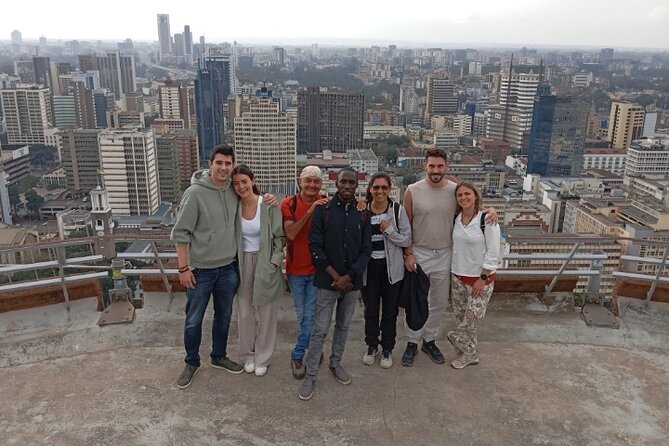
I like this setup for a simple reason: you still get the stop even if you decide not to pay the extra rooftop fee. And if you do go up, you get a clearer sense of how Nairobi sprawls, which makes later history and architecture stops feel more real.
Railway Museum and National Archives on Moi Avenue
As the tour continues, it turns more “how Nairobi got built,” and that’s when the walk starts to feel like more than sightseeing.
At Nairobi Railway Museum, the tour description says the railway was built by the British with help of the Indians from 1985, and that this led to the creation of Nairobi. That is a detail you might not catch if you only look at the city today. Even if you want to question dates or details later, it gives you a starting point to connect infrastructure to growth.
Then you head to National Archives Moi Avenue, where collections of artifacts are kept, including documentation of Kenyan government history since independence. This is a practical stop for travelers who want a grounded understanding. You are not just hearing broad “history talk,” you are seeing that records, documents, and preserved artifacts are part of how a country remembers itself.
Both stops are listed as free admission, and that makes them excellent value add-ons in the itinerary.
Jeevanjee Gardens, a quiet finishing touch in the city center

Before the tour ends, you visit Jeevanjee Gardens, a small park in Nairobi. It is scheduled for about 10 minutes and is free admission.
This kind of closing stop matters. It gives you a calmer final frame after government, markets, and major religious buildings. Instead of rushing out into noise right after the last photo, you get a brief pause, which also helps you absorb what you just learned.
And since the tour ends back at the meeting point, you can simply continue on with your day without needing to figure out your next move from scratch.
Why the guide makes this tour work: John, Samson, and clear explanations
The strongest theme across the experience is the human factor: the guides. The tour includes a certified guide who speaks English and Spanish, and the guide names that show up in the experience feedback include John and Samson.
John is described as friendly and energetic, with explanations in a clear voice, and he is also noted as speaking Spanish well. That matters because a city walk can turn into a blur if you cannot follow what someone is saying. Here, the structure plus the guide’s ability to answer questions keeps the information usable.
I also like that the tour does not feel like a rigid lecture. You get room to ask questions and get additional explanation during the walk, which helps you connect the dots between the mosque, the library, the markets, and the public institutions.
If you want to understand Nairobi through real local commentary, this kind of guided storytelling is the big value.
How long you will be walking, and who this fits best
The duration is listed as about 2 hours 40 minutes, and you can plan your afternoon around that. That said, some experiences can run a bit longer when people ask extra questions or linger in markets, so I recommend building in a buffer if you have another plan right after.
This is also offered with a maximum of 50 travelers, which is large enough that you will see a group dynamic, but small enough that you should still hear your guide and stay oriented. The tour is described as near public transportation and most travelers can participate.
Who this suits best:
- First-timers who want an organized route without paying for private transport
- Travelers who enjoy history, but prefer it explained through real streets and specific places
- People who want a practical souvenir hunt without losing time
If you dislike walking, have mobility limits, or prefer slow museum pacing, you might find this too active. I would still say it is doable for many visitors, but comfort shoes are not optional.
Price and value: $20 for a packed, mostly free route
At $20 per person, this tour is priced like a budget-friendly way to “get your bearings” quickly. The reason it feels like good value is the stop mix and the cost reality: most of the listed admissions are free.
You still get a sweep of Nairobi themes in one loop:
- major religious architecture (Jamia Mosque, cathedral basilica)
- education and city institutions (University of Nairobi)
- two souvenir-focused markets
- a green break (Uhuru Park)
- government and city-view moment (Parliament area, rooftop option)
- museums and records (railway museum, national archives)
The only notable extra cost you might face is the rooftop admission not included at Kenyatta International Conference Center. But even with that, the day is built to stay affordable.
If you are short on time and want maximum payoff per hour, this kind of city walk is often one of the most efficient ways to start exploring Nairobi.
Should you book this Nairobi City Walk Tour?
If you like structured walking tours that teach through real places, I think you should book this. It is built for orientation, with free key stops and a guide who can explain Nairobi in English and Spanish. The market pair is also a strong reason to go, because it gives you two different angles on traditional crafts.
Book it if:
- you want a compact route covering many city themes in one half day
- you want a guide-led explanation, not just a self-guided stroll
- you appreciate a balance of faith, culture, markets, and institutions
Skip it or plan differently if:
- you want mostly indoor time, minimal walking, or you cannot comfortably handle extended foot travel
- you expect every viewpoint cost to be included, since the rooftop admission is not part of the price
FAQ
Is the Nairobi City Walk Tour admission-free at most stops?
Many stops are listed as free admission, including Jamia Mosque, McMillan Memorial Library, City Market, University of Nairobi, Maasai Market, Uhuru Park, Cathedral Basilica of the Holy Family, Parliament of Kenya, Nairobi Railway Museum, National Archives, and Jeevanjee Gardens.
How long is the Nairobi City Walk Tour?
The duration is listed at about 2 hours 40 minutes.
What does the tour cost, and what is included in the price?
The tour price is $20. It includes all fees and taxes, and a certified guide in English and Spanish. The tour uses a mobile ticket.
Which stop has an additional ticket cost?
Kenyatta International Conference Center is listed as admission ticket not included, meaning the rooftop fee is an extra cost.
Where does the tour start and end?
The tour starts at Carrefour St. Ellis PR7F+G34, Wabera St, Nairobi, Kenya, and it ends back at the same meeting point.
How big are the groups, and is it near public transportation?
The tour has a maximum of 50 travelers, and it is noted as being near public transportation.
More Tours in Nairobi






More Tour Reviews in Nairobi


Nairobi at Street Level






Everything else we hold on Nairobi
- 7 Days Private 4 star lodges Safari by LandCruiser from Nairobi★ 5.0 · 3 reviews
- 5 Days/4 Nights Kenya Safari★ 4.5 · 3 reviews
- Safari Park Hotel Show & Dinner Experience In Nairobi Tour★ 3.6 · 3 reviews
- Day safari to Olpejeta Rhino conservancy★ 5.0 · 3 reviews
- 7 Days Breathtaking Kenya Wildlife Private Safari★ 5.0 · 3 reviews
- Overnight Amboseli National Park Safari from Nairobi★ 5.0 · 3 reviews
Nairobi City Tours, compared.
 ★ 5.0Nairobi Historical Walking City TourFrom $35258 reviews
 ★ 4.8Nairobi Walking tour:Explore History Culture and TraditionsFrom $22222 reviews
 ★ 4.7Nairobi Downtown Walking TourFrom $27208 reviews
 ★ 5.0Nairobi City Walking Tour with Traditional Kenyan LunchFrom $45106 reviews
 ★ 4.8Nairobi Walking Tour: Downtown & City TourFrom $2032 reviews
 ★ 4.0vibrant nairobi city tourFrom $3522 reviews
 ★ 4.6Nairobi City Orientation Guided Tour with Lunch at CarnivoreFrom $15020 reviews
 ★ 5.0Nairobi city sights, Giraffe Encounters and Bomas Kenya TourFrom $9519 reviews
Appears in these lists