

REVIEW · NAIROBI CITY TOURS
Half Day – Nairobi City Walking/Bus Tour Museums, Monuments & Rooftop City View
Nairobi hits different when you move like a local. This half-to-full-day small-group tour mixes walking in central Nairobi with rides on matatus (and shared minibuses), while you learn the city’s layered past and what life looks like today. The group stays small, capped at 7, so you are not stuck listening to a history lecture from the back row.
I especially like two parts. First, the National Archives stop is more than a quick photo break, it has African paintings and tribal photographs, plus a huge collection of weaponry, instruments, masks, and other objects tied to different communities across Africa. Second, the KICC rooftop payoff gives you a clear 360-degree view of the central business district, including landmarks like the office of the president and Kenya’s parliament.
One thing to plan for: most of the good stuff is not bundled into the headline price. You pay separate entry fees for the National Archives, Nairobi Railway Museum, and the KICC rooftop. Also, it is a moderate-activity day, with walking plus time on local transport that can feel long.
In This Review
- Key highlights worth planning around
- Entering downtown Nairobi through the National Archives
- Matatus and Kasarani: the city’s rhythm, up close
- Nairobi Railway Museum: why rail mattered for Kenya
- KICC rooftop: the fast ticket to 360-degree orientation
- Price and value: what $61 really covers
- Timing, pacing, and how the 5 to 7 hours feels
- What your small group experience actually feels like
- Who this tour is best for
- Should you book this Nairobi city walking and rooftop tour?
- FAQ
- What is the duration of this Nairobi tour?
- How large is the group?
- What time does the tour start?
- Where do we meet?
- What does the price include?
- What admission fees should I budget for?
- Is there matatu or local transport during the tour?
- How long do we spend at each stop?
- Where does the tour end?
- Is free cancellation available?
Key highlights worth planning around
- Small group size (max 7) keeps the tour personal and helps you ask questions
- National Archives stop goes deep on independence-era history, plus art and cultural objects
- Matatu ride feels like Nairobi in motion, with creative, colorful vehicles
- Railway Museum storytelling connects Kenya’s growth to the development of rail
- KICC rooftop views are 360-degree and let you spot major government buildings
- Admissions are separate, so you can budget a realistic total day cost
Nairobi covered at street level and by minivan
Entering downtown Nairobi through the National Archives
If you want Nairobi without the “check-the-box” vibe, start at the National Archives on Moi Avenue. This is not one of those places you rush through. It is a museum and art gallery that mixes visual culture with real historical context, and it works well for a small-group format because you can slow down without losing time.
Inside, you can expect African paintings and tribal photographs from across the continent. What surprised me most is the breadth of cultural items on display, including a large collection of tribal weaponry, instruments, masks, and other paraphernalia. It is the kind of collection that can help you understand how different communities expressed identity through objects, music tools, and ceremonial items.
The museum also includes exhibits focused on independence and the history of Nairobi. That matters because it gives you a framework for what you see later in the city. You are not just looking at buildings and street scenes. You are learning why certain places and institutions exist.
Practical note: this stop is scheduled for about 1 hour. If you are the type who reads every label, you might want to skim first, then circle back to what catches your eye.
Matatus and Kasarani: the city’s rhythm, up close
After the archives, the tour shifts gear to local transport. You take a two-way ride in Kenya’s matatus, plus time around Kasarani. Matatus are known for their bold designs, often featuring hip-hop artists, international pop stars, athletes, political icons, and even religion. In a way, the vehicles act like rolling billboards, and they can feel like Nairobi’s music and pop culture on the move.
Two hours here is enough time to notice details without turning it into a full travel day. You also get a more grounded sense of the city’s routes and everyday movement patterns, because you are not in a private car that insulates you from local life.
The upside of this segment is energy. The downside is that it is still travel time. If you easily feel restless on rides or you have tight time constraints, this is the part you will want to approach with patience. Think of it like part of the lesson: you are learning how the city functions, not just collecting stamps.
Nairobi Railway Museum: why rail mattered for Kenya
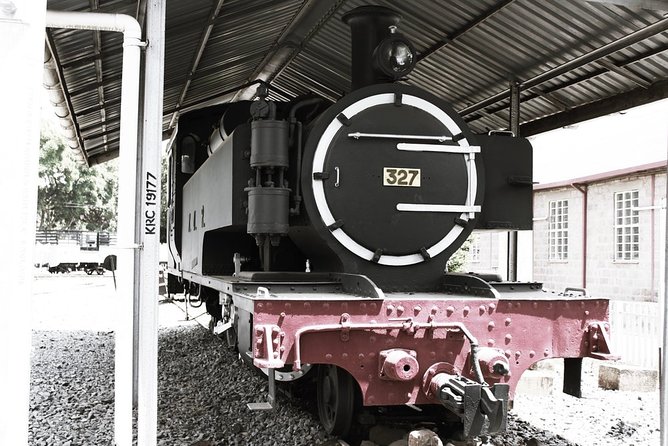
Next comes Nairobi Railway Museum, where the theme becomes national growth and infrastructure, told through the story of railways. This stop is about 45 minutes, so it is best if you treat it as a guided orientation to the topic rather than a deep research session.
What you should expect is a narrative approach to history. The railway museum connects the development of Kenya to the rail system, explaining how the rail helped shape the country’s evolution. In practical terms, it helps you see Nairobi differently. A city does not become important by accident. Transport systems influence where people can live, trade, and build communities.
If you like history that has a cause-and-effect feel, this stop tends to click. Rail becomes the thread linking “then” and “now,” and it gives context for why cities like Nairobi grew into key hubs.
If you prefer hands-on or interactive museums, this might feel more interpretive than hands-on. But for most visitors, 45 minutes is a good length for staying engaged.
KICC rooftop: the fast ticket to 360-degree orientation
The final standout moment is the KICC rooftop at the Kenyatta International Conference Center. You get around 30 minutes up there, and it is time well spent because the view is immediate. The rooftop also doubles as a helipad, and from this height you get a 360-degree look at Nairobi’s central business district.
This is where the tour pays off if you want mental map clarity. After learning about independence-era context at the National Archives and hearing how Kenya’s development ties back to rail, the skyline helps you connect the story to the geography.
You can also spot monumental buildings tied to government, including the office of the president and Kenya’s parliament. Even if you are not a political-history person, you will likely find the concentration of civic buildings from above a useful reality check about how Nairobi operates.
One consideration: because the rooftop time is limited, come prepared to move quickly. If you want photos, aim for a steady flow rather than waiting for the perfect shot for every direction. You only have so much rooftop time, and you will likely want to see the whole horizon, not just one angle.
Other Nairobi bookings that survived the same scrutiny
Price and value: what $61 really covers
Let’s talk money in plain terms. The tour price is $61 per person. The included part is the guiding fee. That means the headline price covers your guide and the guided experience, not the museum and rooftop admissions.
You should budget separate entry fees for:
- National Archives: about $3
- Nairobi Railway Museum: about $3
- KICC rooftop: about $5
Add it up and your likely total for admissions comes to around $11. So a realistic all-in cost is about $72 per person, depending on how the provider handles ticket purchases and any on-site logistics.
Is it worth it? For me, the value comes from the mix. You get multiple themed stops tied together by transport and walking, plus the rooftop view that helps you orient yourself in a city that can feel big and complex. Also, the group cap of 7 means you are not paying for a mass-market bus tour. You are paying for a guide-led day with time to ask questions and adjust pacing.
Where it might not be worth it is if you have zero interest in museums. If you want only scenic viewpoints, you might end up paying for stops you do not care about. But if you like context, this is a strong way to spend half to full-day time without planning everything from scratch.
Timing, pacing, and how the 5 to 7 hours feels
The schedule lists the major stops with these durations:
- National Archives: 1 hour
- Matatu ride to Kasarani: 2 hours
- Nairobi Railway Museum: 45 minutes
- KICC rooftop: 30 minutes
Those segments total 4 hours and 15 minutes on paper. The overall length is listed as 5 to 7 hours, which is reasonable once you factor in walking between areas, brief transitions, and time to regroup as a group.
For your planning, the key is that this tour is not a tight “run and gun” half-day. It is structured enough to move through several meaningful places, but it also leaves room for you to absorb what you see. The small group also helps, because if you pause for questions or a better view angle, you are not holding up a huge group.
Wear shoes you are comfortable walking in. You have a moderate physical fitness level requirement, so it is not an all-day hike. Still, you are on your feet at least during the walking segments and around museum areas.
What your small group experience actually feels like
I like small group tours for one big reason: the guide can tailor pace and attention. With a maximum of 7 people, you can ask quick questions that make the history land better. You also avoid that awkward feeling of being one of many faces while the guide talks in “generic mode.”
In this case, the walking portion across central parts of Nairobi adds a lot of texture. The feel is like getting your bearings fast and then getting a guided sense of what to notice. In my experience, the guide was a pleasant young man with solid knowledge of the area, and it showed in how he connected sites to the bigger story rather than reciting dates.
If you are traveling solo or with one partner, this group size can feel especially friendly. You get social energy without the chaos of a large group.
Who this tour is best for
This tour fits well if you want a balanced day: museums and monuments, plus real city movement. It is a smart choice if you:
- like understanding the “why” behind what you see
- enjoy public spaces and local transport culture
- want an organized route without spending your day building one
- appreciate a guided viewpoint, especially from a rooftop
It may not be the best match if you:
- dislike local transport time and prefer private sightseeing only
- want purely outdoor sightseeing with minimal indoor time
- get restless in a schedule that has a few moving parts
Should you book this Nairobi city walking and rooftop tour?
I would book this if you want a structured introduction to Nairobi that goes beyond the most obvious sights. The National Archives stop gives you context you can carry into the rest of the day, the Railway Museum connects that context to development, and the KICC rooftop turns it into something you can picture instantly.
I would skip it if your priority is only panoramic sightseeing and you do not care about museum content. In that case, the separate entry fees plus the transport segment might feel like extra.
If you are on the fence, here is a simple decision rule: if you enjoy history that explains how cities and countries grew, and you want a guided small-group route with a strong viewpoint at the end, this is a very solid choice for a first or second day in Nairobi.
FAQ
What is the duration of this Nairobi tour?
The tour runs about 5 to 7 hours.
How large is the group?
It is a small-group tour with a maximum of 7 travelers.
What time does the tour start?
The start time is 8:30 AM.
Where do we meet?
You meet at the National Archives on Moi Avenue, at 30 Moi Ave, Nairobi, Kenya.
What does the price include?
The price includes the guiding fee. Admission tickets are purchased separately.
What admission fees should I budget for?
The National Archives is about $3, the Nairobi Railway Museum is about $3, and the KICC rooftop is about $5.
Is there matatu or local transport during the tour?
Yes. You take a two-way ride in Kenya’s matatus, including time around Kasarani.
How long do we spend at each stop?
National Archives is about 1 hour, the matatu ride portion is about 2 hours, the Railway Museum is about 45 minutes, and the KICC rooftop is about 30 minutes.
Where does the tour end?
The tour ends back at the meeting point.
Is free cancellation available?
Yes. You can cancel for a full refund up to 24 hours before the experience starts.
More Tours in Nairobi






More Tour Reviews in Nairobi


Nairobi at Street Level






Everything else we hold on Nairobi
- 7 Days Private 4 star lodges Safari by LandCruiser from Nairobi★ 5.0 · 3 reviews
- 5 Days/4 Nights Kenya Safari★ 4.5 · 3 reviews
- Safari Park Hotel Show & Dinner Experience In Nairobi Tour★ 3.6 · 3 reviews
- Day safari to Olpejeta Rhino conservancy★ 5.0 · 3 reviews
- 7 Days Breathtaking Kenya Wildlife Private Safari★ 5.0 · 3 reviews
- Overnight Amboseli National Park Safari from Nairobi★ 5.0 · 3 reviews
Nairobi City Tours, compared.
 ★ 5.0Nairobi Historical Walking City TourFrom $35258 reviews
 ★ 4.8Nairobi Walking tour:Explore History Culture and TraditionsFrom $22222 reviews
 ★ 4.7Nairobi Downtown Walking TourFrom $27208 reviews
 ★ 5.0Nairobi City Walking Tour with Traditional Kenyan LunchFrom $45106 reviews
 ★ 4.8Nairobi Walking Tour: Downtown & City TourFrom $2032 reviews
 ★ 4.0vibrant nairobi city tourFrom $3522 reviews
 ★ 4.6Nairobi City Orientation Guided Tour with Lunch at CarnivoreFrom $15020 reviews
 ★ 5.0Nairobi city sights, Giraffe Encounters and Bomas Kenya TourFrom $9519 reviews
Appears in these lists